

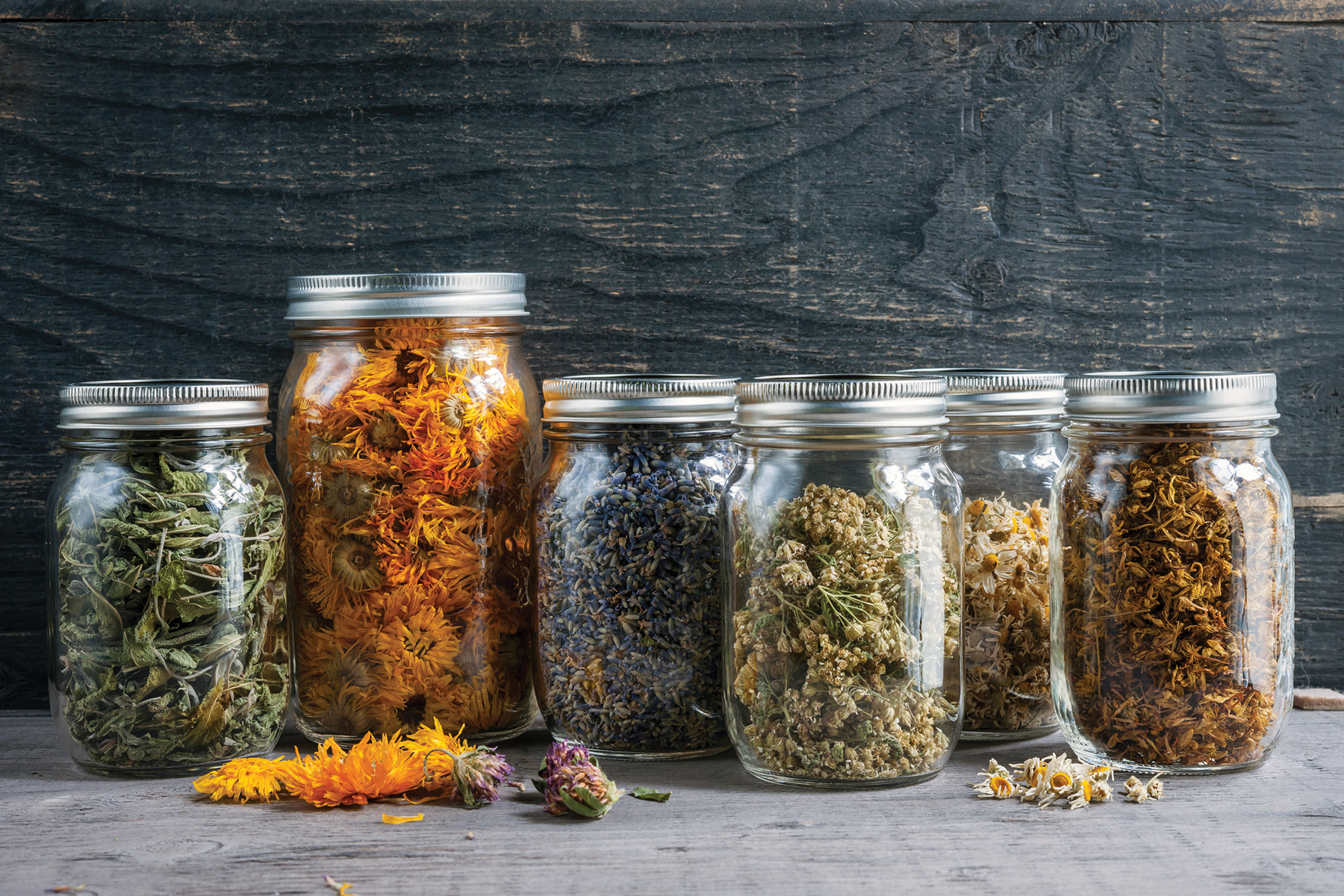
As the calendar year turns over, many people attempt to turn over a new leaf with it. But on the path to better health, you’ll encounter numerous obstacles, from a stressful day at work to a bad night of sleep to the cravings that may accompany an attempt at Dry January or long-term sobriety.
You might as well plan for some off days (remember to seek progress, not perfection) – and when they happen, plants can help you get back on track. Many of the following herbs are notable for accommodating multiple concerns. You might use lemon balm for stress relief and find that it helps you sleep better as well – and then sleeping better may lower your stress even further. So, you don’t need to try all of these at once; see if even one can lift your spirits enough to bolster your confidence or help you bounce back from a bad day.
Start slowly when taking any new-to-you herb to see how your body responds, and consult your health-care practitioner to ensure you’re aware of how each plant could interact with any conditions or medications. Dosage recommendations vary; for tea made with each of these plants, I drink 2 cups per day, and for tinctures, I follow the guidelines on the bottle or in the recipe.
A final disclaimer: I use the folk method of making tea, meaning I eyeball my proportions. You may prefer more or less than I suggest – particularly if you’re using freshly harvested herbs, in which case, you’ll want to roughly double the amount.
Herbs for Stress
Lemon Balm
Lemon balm (Melissa officinalis). At the start of the pandemic – an undeniably stressful time – I lived in an apartment with south-facing windows that would get scorching hot, even in spring. The apartment had no AC and poor airflow, so the idea of putting water on to boil for tea wasn’t enticing. When I read that both lemon balm and hibiscus were suitable for a cold infusion (basically, a tea brewed in cold water), and that each of these plants could help your body cool down, I threw a tablespoon of each into a jar and put it into the refrigerator. A couple of hours later, I was delighted to pull out a cooling, jewel-toned tea – and I was amazed at how relaxed I felt after drinking it. I’ve since tried lemon balm in all kinds of preparations, and always to the same effect: a serenity that washes over my body and puts me at ease.
Hence the “balm” part of its name – this lemon-scented herb can calm your nervous system and boost your mood. Herbalists have used it for centuries to soothe minor anxiety, restlessness, and mild depression, and to improve quality of sleep. It can also lessen digestive upset, especially when it’s related to anxiety.
Lemon balm has a bright, citrus flavor that makes a mild tea. Add 1 tablespoon of dried leaves to each cup of hot water for tea, or 1/4 cup of dried leaves to each quart of cold water for a cold infusion. As for my COVID-19-era cold infusion, I attributed my boosted mood to the lemon balm, but the hibiscus likely played a part too. It’s good for the heart, and I love combining the two.
Motherwort
Motherwort (Leonurus cardiaca). Early in my career, the co-worker I sat closest to – a budding herbalist – always kept a tincture of motherwort handy for stressful deadlines, swearing it helped settle the nervous system spikes that came with striving to hit our targets. So, I tried it myself, and sure enough, motherwort comforted me when I was feeling overwhelmed and my heart was racing.
Motherwort’s botanical name, meaning “lion-hearted,” points to the plant’s traditional uses for regulating heart palpitations and elevated heart rate, and alleviating tension, stress, and minor anxiety.
This beneficial herb is pretty bitter, so it won’t make the most appetizing tea. For that reason, I tend to hasten my consumption by taking a dropperful of the tincture in a shot glass of water. (I still know how to party.) To make motherwort tea, use about 1 tablespoon of dried herb per cup of water.
Rhodiola
Rhodiola (Rhodiola rosea). During a period of intense stress in my life, my therapist recommended that I try rhodiola, and I’ve never looked back. I take it in a blended tincture from The Herbalist called Adapt to Life, and indeed, rhodiola’s adaptogenic properties can reduce stress and minor depression to help you navigate those states.
Cultures around the world have used rhodiola for food and medicine; in the latter category, it’s known to increase energy while simultaneously easing stress and minor depression. Research shows that rhodiola is best when taken on an empty stomach early in the day, and that while lower doses can lead to energy, larger doses can have the opposite effect.
For tea, decoct the root by simmering 1 to 2 teaspoons of dried root in 1 to 1-1/4 cup of water for 15 minutes, and then steep it, covered, for an additional 45 minutes. This plant is vulnerable to overharvest, so purchase it from companies that use cultivated sources.
Herbs for Sleep
Hops
Hops (Humulus lupulus). I’ve struggled with sleep since I was a teenager – staying up late into the night became second nature. But when the lack of sleep started catching up to me, I needed a way to drift off more quickly. I’d heard that hops could make you sleepy (and, indeed, beer often did, back when I drank it), so I purchased a tincture from the local co-op, and the first night I tried it, I fell asleep fast and slept soundly. It worked so well that I started evangelizing its powers to anyone in my circle who, like me, would lie awake at night watching the hours inch by and wondering what would work.
Hops have an age-old reputation as a calming sedative. They’re often combined with other herbs, such as valerian root and passionflower, to form a more comprehensive sleep aid, but for me, even the single-herb formulation in a tincture or tea works wonders.
A dropperful of tinctured hops takes me to dreamland in no time. (It’s another bitter one, so I wash it down with water.) For tea, use 2 teaspoons of dried hops flowers per cup of water.
Lavender
Lavender (Lavandula spp.). You’ve probably already heard about lavender’s link to sleep – but it’s common for a reason. Lavender is my go-to for winding down, from applying lavender-scented lotion before bed to keeping lavender-filled sachets and eye masks near my pillow to diffusing lavender essential oil in my bedroom to sprinkling the little flowers over a late-night cup of tea. Plus, where I live, it grows abundantly, ready to be clipped regularly and tucked into my sleep routine.
Using lavender as a sleep aid is backed by years of anecdotal evidence and recent scientific evidence – it helps you fall asleep faster and sleep more soundly. And you don’t have to consume it; lavender’s aroma also acts as a relaxant. An herbal foot soak or a bath infused with lavender can lessen tension. And my mother sewed me a rice-filled heating pad scented with lavender that I can warm up and then place around my shoulders at the end of a long day, an herbal hug to lift my spirits.
For tea, I tend to use a little less because of the potency of its flavor and fragrance; try 1 teaspoon for each cup of water, and steep for about 20 minutes.
Passionflower
Passionflower (Passiflora incarnata). Where I grew up in Kansas, some people know this plant as “maypop,” with its striking firework of a flower and its apricot-sized fruit. I started to see passionflower listed in every herbal blend I bought for sleep, so as lively as the plant itself looks, I figured its impacts on the human body must be more soothing.
Passionflower is frequently used to support sleep; it can address general restlessness as well as sleeplessness. Herbalists have noted its ability to reduce tension and mild anxiety.
My favorite formulation is Wooden Spoon Herbs’ Rose-Colored Glasses, in which it’s blended with rose, oat tops, and hawthorn. For tea, I add about 2 teaspoons of dried herb in 1 cup of boiling water and let it steep for about 20 minutes.
Herbs for Sobriety
If you’re taking a brief break from drinking or stopping altogether, herbs can help ground you in your new normal. But because sobriety might require more than a handful of plants, talk to your health-care provider about possible withdrawal symptoms and additional treatment options.
You might also want to consider the form in which you consume these herbs. If you want to avoid alcohol entirely, try capsules, glycerites, and teas instead of tinctures.
Kava
Kava (Piper methysticum). This plant has a rich history, across thousands of years, in Pacific Island traditions, in which it’s used medicinally, ceremonially, and socially to commemorate significant moments. I recently visited a tea house with a section dedicated to a drink made of kava root and water, which was given to interested guests in a small bowl with instructions for following a simple ritual before drinking the entire offering all at once. Within minutes, I could feel its effects – relaxation replaced my stress and loosened the tension I hold in my shoulders and back.
Kava acts fast on mild anxiety, stress, sleeplessness, and sometimes nausea. It also has anesthetic properties, so it may make your tongue tingle when you take it. When I first stopped drinking alcohol, kava helped me feel calm during intense cravings. Those seeking relief from addiction are sometimes advised to be cautious with kava, as it can become a mild substitute for the substance you’re avoiding. Kava carries some additional risks, including the potential to harm your liver, so check with your health-care provider and consider its support short-term for the toughest days.
Because the plant is vital to South Pacific cultures and is declining in the wild, buy sustainably cultivated sources. I tend toward taking tinctured kava, but it’s exceedingly bitter; the tea I was served at the tea house was far more palatable. Use only the powdered or whole root for tea, and know roughly the amount of kavalactones (the active components of kava) in each serving. Medical experts recommend that you keep your daily consumption at or below 250 milligrams of kavalactones.
Skullcap
Skullcap (Scutellaria lateriflora). Early in my sobriety, a friend of mine recommended skullcap to help with a spinning mind. My mind would race most often when I was still encountering cravings throughout the day.
This nervine can nourish the nervous system and is traditionally used for exhaustion, tension, stress, and restlessness. So, I could readily recommend skullcap for stress and sleep support as well – but it’s been an excellent ally in my sobriety because of how it soothes my mind.
I take powdered skullcap in capsules from Eclectic Herb. You can also make skullcap tea. Steep 1 teaspoon of dried herb in 1 cup of boiling water.
Daily Rituals
Ritual has been an important part of my recovery, just as it was a keystone of my consumption. From pouring a liquid over ice to lighting up and inhaling, you may feel that something critical – something beyond the substance – is missing if you quit without that ritual element. If your routine entails a drink that indicates it’s the end of the day, choose a flavorful tea or sparkling nonalcoholic beverage instead. If you’re used to stepping outside for a smoke, step outside with tea and take deep breaths of fresh air. If you’re accustomed to packing a pipe with powerful herbs, fill a tea strainer with … different herbs.
And if those rituals remind you too much of what you’re trying to renounce, build new ones. Maybe a foot soak is your new after-work relaxation technique. Perhaps you need a book series to sink into when you have cravings. Find substitutes you can add to your routine, instead of solely focusing on what you’re subtracting. In that sense, building a ritual around your favorite tea blend can lead to success, even if it doesn’t include any of the herbs listed here. Follow your intuition and pay attention to how you respond to each plant; this will guide you to your best solutions for stress, sleep, and sobriety.
Resources
Eclectic Herb: www.EclecticHerb.com
Herbal Academy: www.TheHerbalAcademy.com
The Herbarium: www.Herbarium.TheHerbalAcademy.com
The Herbalist: https://Store.TheHerbalist.com
Mountain Rose Herbs: www.MountainRoseHerbs.com
Wooden Spoon Herbs: www.WoodenSpoonHerbs.com
Amanda Sorell is a storyteller who lives in Seattle. She’s an editor for Mother Earth News and is passionate about food access and foraging. Read her newsletter at eClips.Substack.com.
