

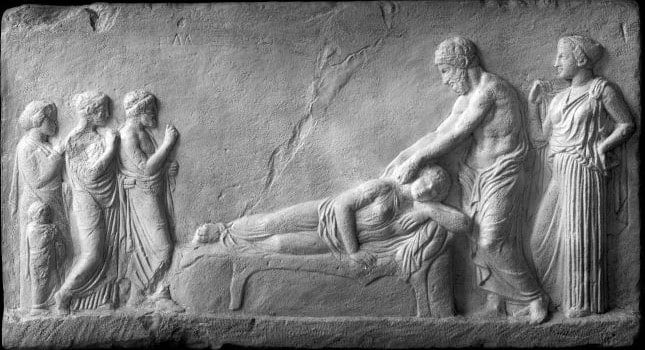
Ancient Greek health secrets offer unique insights into a better and longer life focusing on balance, diet, and mindful routines. Wellcome Images/ wikimedia commons CC-BY-4.0.
The secrets to living a longer and healthier life exist in modern medicine, but those shared by ancient Greek physicians can’t be ignored. Ancient records show that Gorgias of Leontini, a renowned ancient Greek sophist and pre-Socratic philosopher, lived to be 108 years old. He was born in 483 BC and is believed to have died around 375 BC.
Gorgias was a student of Empedocles and the teacher of Isocrates. He delivered a series of speeches that dazzled the Athenian audiences and won him fame and admiration. Upon completion of his mission, he traveled throughout Greece as a teacher of rhetoric and as an orator.
As Gorgias grew older, people often wondered how he could have possibly had such a long life. They asked him about his secrets.
Gorgias once answered, “I never did anything for the sake of pleasure.” This response might have been playful—Gorgias was known for his witty humor. However, other sources suggest his real secret was simple: he lived a balanced life.
Even to this day, people wonder how to live in a way that keeps them healthy and happy for many years. This question is nothing new. Long ago, some of history’s most famous thinkers also wondered about how to live longer.
Balanced lifestyle from Greek physician Galen
The renowned ancient Greek physician Galen, who practiced in Rome around 129 to 216 AD, observed that many of his patients’ health issues stemmed from poor lifestyle choices.
“Galen of Pergamon was, after Hippocrates, the most influential physician of the classical world, his reputation extending well into the 19th century.” His works, written in Greek, were also foundational in the field of medicine in the medieval Roman Empire!
The 2nd century… pic.twitter.com/R0KfNkGyIs
— ShadowsOfConstantinople (@RomeInTheEast) November 6, 2024
“Every year I see very many who are sick through such a cause,” he said. Galen believed his patients’ health suffered due to several factors, such as:
“…living an idle life, or working too hard, or being in error regarding the qualities, quantities, or times of foods, or practicing some exercise that is harmful, or erring in regard to the amount of sleep, or excessive indulgence in sex, or needlessly tormenting themselves with grief and anxiety.”
Galen admired the disciplined lifestyle of another Greek physician, Antiochus, who, even in his eighties, kept a daily routine of long walks and followed a strict diet.
Antiochus’ preferred foods were simple but nourishing. He enjoyed bread with honey, deep-sea fish, a porridge mixed with oxymel (a blend of honey and vinegar), and bird meat with a light sauce.
These choices reflected Galen’s belief that balance and simplicity are key and the Greek secrets to a longer, healthier life.
Daily routine of Titus Vestricius Spurinna
Around 100 AD, Pliny the Younger, a lawyer, author, and magistrate of Ancient Rome, wrote about the daily routine of Titus Vestricius Spurinna.
He was a Roman senator and consul who lived a disciplined life even into his seventies. Spurinna balanced exercise with relaxation to stay healthy.
“Every morning he stays in bed for an hour after dawn, then calls for his shoes and takes a three-mile walk to exercise mind and body,” Pliny wrote.
“When summoned to his bath in the afternoon, he first removes his clothes and takes a walk in the sunshine if there is no wind, and then throws a ball briskly for some time, this being another form of exercise whereby he keeps old age at bay.
“After his bath he lies down for a short rest before dinner, and listens while something light and soothing is read aloud.”
